In the previous posts, we built the infrastructure and mapped the catalog. But a large catalog is a liability if the Unit Economics don’t math out. To build a system that scales to 8 figures, you don’t just look for “high demand”; you look for Operational Purity.
The goal is to identify products that enter your system, generate cash, and leave your warehouse without ever coming back or requiring a human to explain how they work.
1. The “Zero-Friction” Product Profile
A high-profit system thrives on simplicity. When selecting products for your verticals, they must pass the Frictionless Test:
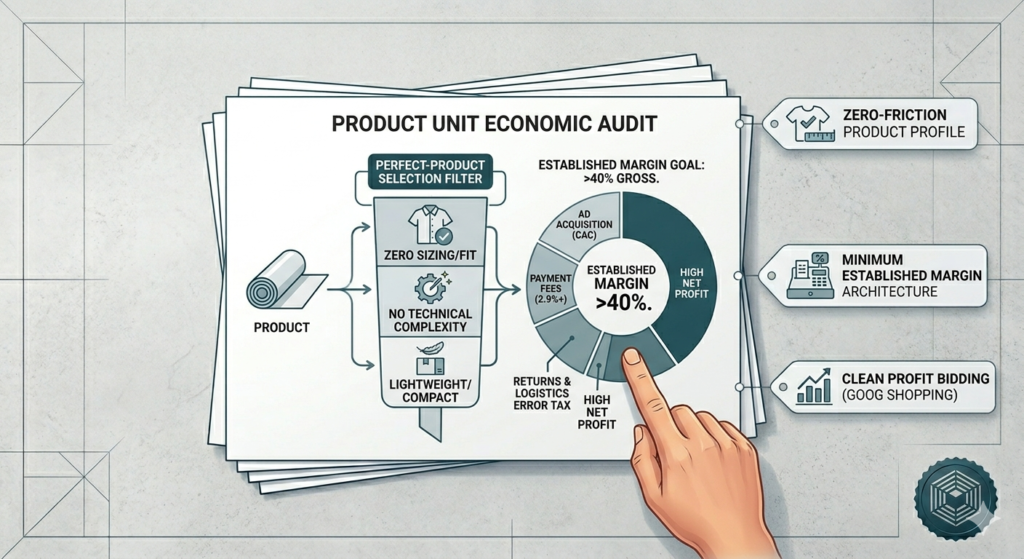
- No Sizing, No Fitting: Apparel has a 30% return rate in the US due to “fit issues.” Our system targets products that are Size-Agnostic. If it doesn’t have a size, it doesn’t have a “return-to-origin” cost.
- Low Technical Complexity: If a product requires a manual or a technical support call, your margin is being eaten by customer service hours. We want “Plug & Play” or “Apply & Forget” items.
- Weight-to-Value Ratio: Shipping air is expensive. We prioritize products with low weight and high durability. If it’s heavy or fragile, your shipping insurance and carrier fees will kill your Google Shopping competitiveness.
2. Engineering the “Safety Margin”
In 2026, a 20% gross margin is a hobby, not a business. A scalable system requires a Minimum Established Margin to survive the “invisible taxes” of Ecommerce:
- The 3:1 Rule: For every $1 spent on Ad Acquisition (CAC), you should ideally see $3 in Gross Profit.
- The Return Tax: Even with size-agnostic products, you must factor in a 3-5% “ghost cost” for damages or logistics errors. If your margin is thin, one bad batch of shipments can put your cash flow in the red.
- Payment Gateway Friction: Don’t forget the 2.9% + $0.30 fee for every transaction. In high-volume systems, this is a significant operational cost.
3. Google Shopping: Bidding on “Clean” Profit
Your system should use data to prioritize Clean Sales.
- The High-Profit Tier: Products with low weight, no returns, and >40% margin. These get aggressive bids.
- The “Anchor” Tier: Products that might have lower margins but high repeat purchase rates (LTV).
- The Death Zone: Products with high weight or technical returns. Even if they sell fast, your Business Analysis will show they are draining your resources. Kill them.
4. What’s Next: Semantic SEO & The Content Gap
Now that we have a profitable, low-friction catalog, we need to make sure the right people find it without us overpaying for every single click. In the next post, we will dive into Semantic SEO Architecture: how to find the “Content Gaps” your competitors are missing to feed your system with organic, high-intent traffic.